A bathroom door should be chosen according to humidity, size, ventilation, material and privacy, not just colour. In a bathroom, the door is exposed to steam, condensation and daily use, so the installation, the frame, the hardware and the finish matter just as much as the design.
In this guide you will learn how to choose a bathroom door suited to a premium flat, a new house or a renovation: which materials hold up best, which sizes are common and which ventilation options you have. At Kulttur, all interior doors can be configured for the bathroom.
TL;DR: A good bathroom door must withstand humidity, provide privacy, allow ventilation and match the size of the bathroom. For small bathrooms, sliding solutions or 60–70 cm doors can save space. For premium projects, the door can be configured to order according to material, finish, glass, frame and hardware.
See Kulttur interior doors for the bathroom
How to choose the best door for a bathroom
The best door for a bathroom is the door that suits the real conditions in the room: humidity level, available space, ventilation, traffic and design. There is no single option that suits every bathroom. The right choice depends on how the space is used.
Check these criteria before ordering:
- humidity resistance — the bathroom produces steam and condensation;
- door size — 60 or 70 cm are common for bathrooms;
- opening direction — it matters in small bathrooms or narrow hallways;
- material — veneer, laminate, glass or other compatible finishes;
- ventilation — grille, slots, sleeves or another discreet solution;
- privacy — solid door, frosted glass, sandblasted or opaque glass;
- hardware — handles, hinges and locks suited to the bathroom;
- design — white, grey, black, natural wood or a sliding door.
If the bathroom is small, has no window or is used intensively, put ventilation and material first. If the bathroom is part of a master bedroom or a premium project, visual integration matters more: the same finish as the rest of the doors, frosted glass or a sliding system.
How humidity-resistant should a bathroom door be
The best door for a bathroom is not one single solution. You need to take into account all the particulars of your bathroom and choose the best door for your bathroom.
A bathroom door must withstand steam, condensation and temperature differences without swelling, warping or losing its finish. Humidity resistance depends on the material, the finish, edge protection, ventilation and installation.
A door unsuited to the bathroom can develop problems such as:
- swelling of the edges;
- peeling of the finish;
- condensation stains;
- a persistent damp smell;
- hinges affected by corrosion;
- a frame degraded at floor level;
- mould appearing around the door opening.
For the bathroom, do not choose on looks alone. A plain white door or a wooden door may look good, but it should be checked for use in a damp space.
The wooden doors in the Kulttur collection can be used in the bathroom if the space has proper ventilation, a stable structure and a suitable finish.
CPL/HPL laminate doors can be a good choice for the bathroom if the space is properly ventilated. They can be configured with frosted glass or discreet ventilation slots.
For bathrooms with high humidity, look for:
- a surface resistant to frequent cleaning;
- protected edges;
- a finish compatible with steam;
- a correctly chosen frame;
- hardware resistant to damp;
- functional ventilation;
- installation without joints exposed to water.
Bathroom door sizes
The size of a bathroom door is chosen according to the masonry opening, the interior space and comfort of use. In many homes, the bathroom door is 60 or 70 cm wide, but for better access or generous bathrooms an 80 cm door can also be suitable.
Standard sizes for bathroom doors
Standard sizes for bathroom doors are usually 60 × 200 cm or 70 × 200 cm for the door leaf. In new builds or premium projects, taller or wider doors may also appear, especially if the design calls for uniform proportions with the rest of the home.
Made-to-order bathroom doors
Made-to-order bathroom doors are suitable when the opening does not match standard sizes, when you want the same design as the rest of the doors or when you need a specific material or finish. In renovations, openings can be crooked, too narrow or altered by finishes.
Choose made-to-order bathroom doors when:
- you have atypical openings;
- you want a door taller than the standard;
- the bathroom is part of a unified design concept;
- you need frosted, sandblasted or bespoke glass;
- you want an adjustable frame or a concealed frame;
- the space calls for a sliding solution;
- you need discreetly integrated ventilation.
Doors for small bathrooms
For small bathrooms, the door should save space and not block the sanitary fixtures. A 60 cm door can be enough, but the opening direction and the position of the furniture are just as important as the width.
Useful solutions for a small bathroom:
- a 60 cm door, if the opening and use allow it;
- a 70 cm door, if you want more comfort;
- a sliding door, if a hinged door blocks the space;
- frosted or sandblasted glass, if you want light without losing privacy;
- ventilation slots or a grille, if the bathroom does not have enough airflow.
For a sliding bathroom door, treat the solution as a technical decision, not just a design choice. A sliding door can save space, but it needs a clear wall, a correctly fitted rail and a closing system suited to privacy.
The opening direction of bathroom doors
The opening direction of the bathroom door should be chosen according to available space, safety and the circulation route. In small bathrooms, opening outwards or a sliding solution can be more practical than the classic inward opening.
A bathroom door can have:
- inward opening — a common option, suitable when the bathroom has enough space;
- outward opening — useful in small bathrooms, where the leaf would block the sanitary fixtures;
- sliding opening — suitable when you want to save lateral space;
- filomuro / integrated opening — suitable in minimalist projects, if it is compatible with the space.
Inward opening can be comfortable in larger bathrooms, but it can become awkward when the door hits the toilet, the washbasin, the radiator or the shower enclosure. In very small bathrooms, outward opening can improve efficiency because access stays easier.
Before choosing the direction, check:
- where the sanitary fixtures are;
- where the light switch is;
- whether the door hits the furniture;
- whether the hallway allows outward opening;
- whether there is another door nearby;
- whether a sliding system would work better.
Which materials and types of door are used for the bathroom
For the bathroom, laminate doors, doors with a suitable veneer, glass doors or sliding solutions are used, depending on humidity, style and budget. The material should be chosen together with the ventilation, because no door works well in a permanently damp bathroom.
| Bathroom door type | Advantages | Watch out for |
|---|---|---|
| Veneer / laminated wood | natural, premium, warm look | ventilation, finish, edge protection |
| CPL/HPL laminate | good resistance to daily use, easier cleaning | choosing the right range for the bathroom |
| Frosted / sandblasted glass | light, privacy, resistance to damp | hardware, condensation marks, cleaning |
| Sliding | space saving | clear wall, rail, more limited sound insulation |
| Filomuro | minimalist design | precise installation, compatibility with the finishes |
Veneer bathroom doors
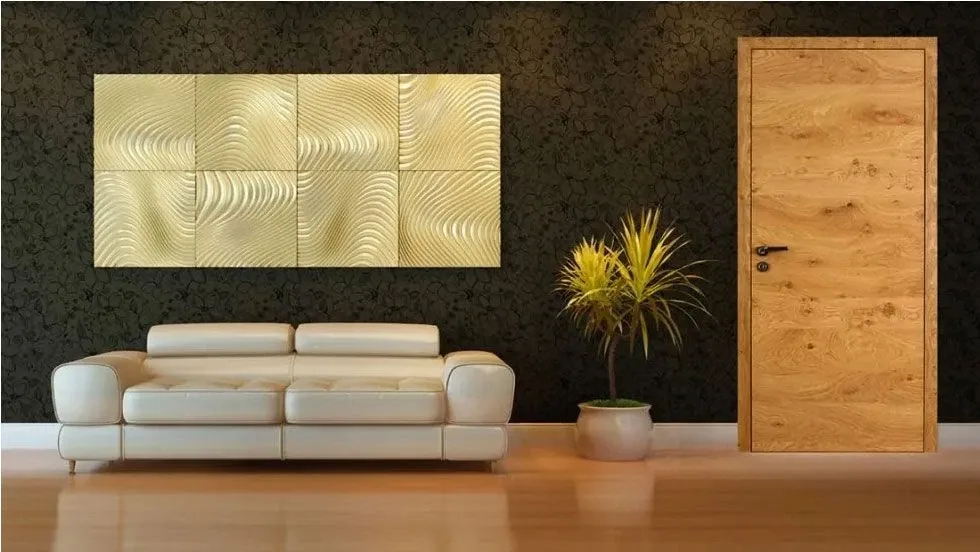
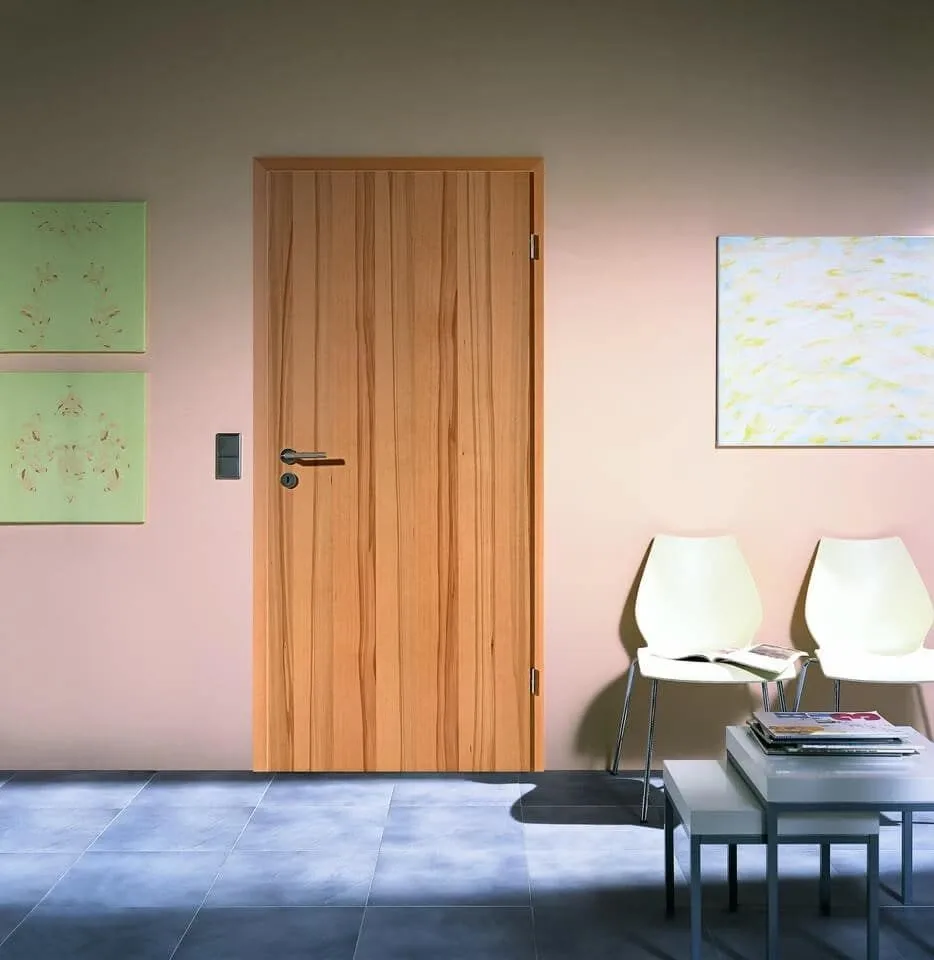
Veneer bathroom doors are suitable when you want a natural look and premium integration with the rest of the home. Veneer brings texture and visual warmth, but it needs proper ventilation and a finish suited to a space with steam.
Choose veneer for the bathroom if:
- the bathroom is well ventilated;
- there is no constant exposure to steam;
- you want continuity with the flooring or the furniture;
- you prefer a solid, visually warm door;
- the project has natural finishes.
Avoid veneer in bathrooms without ventilation, where the door is exposed daily to persistent steam. In such cases, talk to a consultant about the finish, edge protection and a laminate or glass alternative.
Laminate bathroom doors (CPL/HPL)
CPL/HPL laminate doors are a practical choice for the bathroom, especially when you want resistance to daily use and simpler maintenance. The laminate surface suits projects where the door has to look good but also withstand frequent cleaning.
Choose laminate for the bathroom if:
- you want easier maintenance;
- the bathroom is used daily;
- you prefer modern, uniform finishes;
- you need a discreet and practical door;
- you want white, grey, black or neutral-tone options.
For the bathroom, always check whether the chosen model is recommended for humidity. Not all laminate doors perform the same.
Glass bathroom doors
Glass bathroom doors are suitable when you want light, modern design and good resistance to humidity. For privacy, choose frosted, sandblasted, opaque or custom-patterned glass.
Alongside glass doors, at Kulttur we also offer interior doors with glass that is frosted, sandblasted or stained, options suited to bathrooms and spaces where privacy is a priority.
Choose glass for the bathroom if:
- you want natural light in the hallway;
- the bathroom is small and you want a more open visual feel;
- you prefer minimalist design;
- you want a door that is easy to clean;
- you accept maintaining water or condensation marks.
See the interior doors in the Kulttur collection
You can compare veneer, laminate, glass and sliding systems according to your bathroom.
Bathroom door design: how to match it to the style of the bathroom
The design of the bathroom door should tie the bathroom to the rest of the home. The colour, the material and the type of opening should be chosen according to the style of the hallway, the finishes in the bathroom, the flooring or tiles, and the desired level of privacy.
For a coherent project, do not choose the bathroom door separately. Check:
- the colour of the other interior doors;
- matching the doors with the skirting and the flooring;
- the tiles and the bathroom furniture;
- the colour of the hallway walls;
- the type of handle;
- the finish of the taps and accessories;
- whether you want a solid door, one with frosted glass or a sliding one.
White bathroom doors
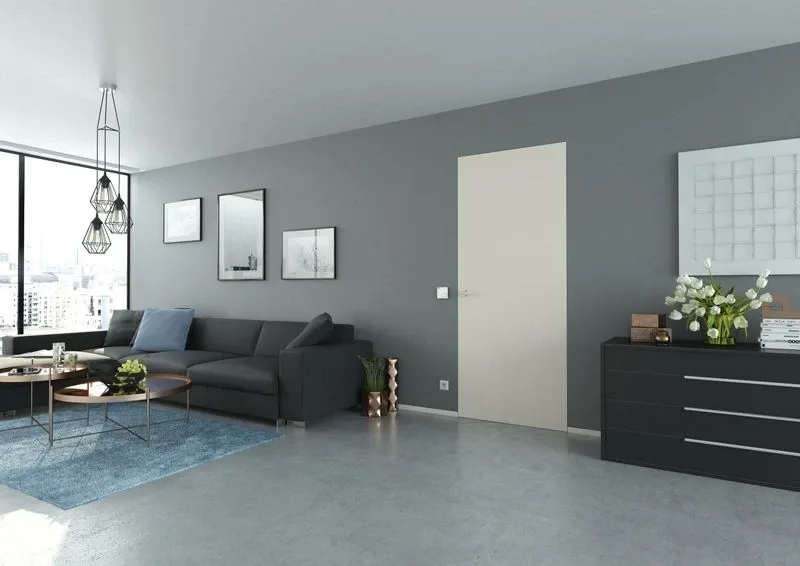
White bathroom doors are suitable for bright bathrooms, minimalist interiors and flats where you want a clean look. White integrates easily with light tiles, white or grey furniture and natural wood.
Choose a white bathroom door if you want:
- a sense of a brighter space;
- continuity with white walls;
- a simple and discreet design;
- compatibility with Scandinavian, modern or classic style;
- a door that does not visually crowd the hallway.
For the bathroom, check the white finish: matt, satin, gloss or textured. In damp areas, the finish and the edges matter more than the shade.
Grey bathroom doors
Grey bathroom doors are suitable for modern schemes, bathrooms with stone, exposed concrete, anthracite tiles or furniture in neutral tones. Grey can look premium without being as contrasting as black.
Choose grey if:
- the bathroom has grey tiles, stone or marble;
- you want a discreet contrast with white walls;
- you have black or chrome hardware;
- you want a modern door that is easy to integrate.
Grey works well for both laminate and painted doors. For unified projects, you can keep the same colour for all interior doors, including the bathroom.
Black bathroom doors
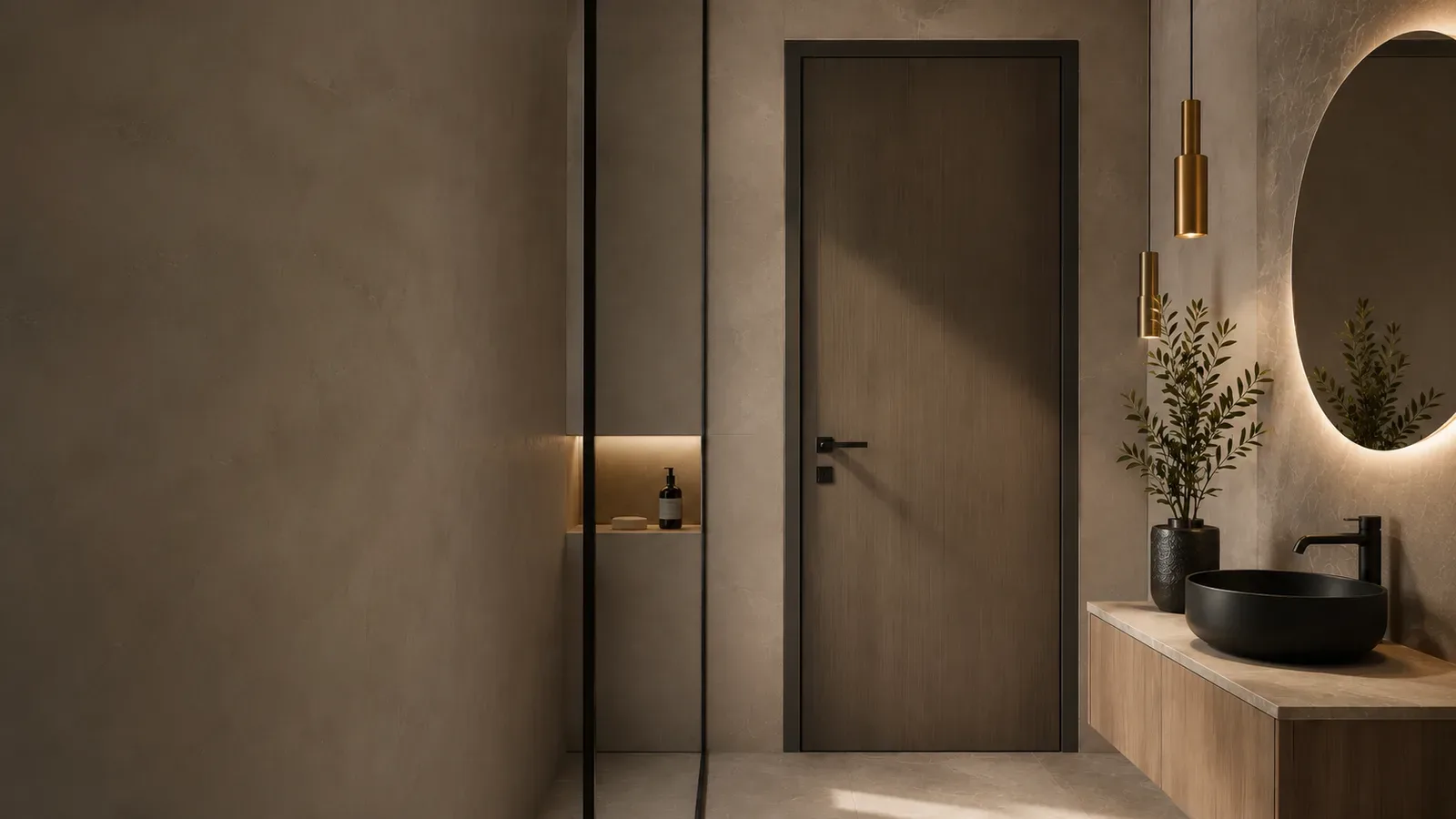
Black bathroom doors are suitable for contemporary interiors, bathrooms with graphic accents and projects where the door becomes a design element. Black does require care, though: it can visually crowd small spaces.
Choose a black bathroom door if:
- you have black hardware in the bathroom;
- you use black profiles on the shower or mirrors;
- the hallway has enough light;
- you want a strong contrast;
- the rest of the scheme supports this choice.
In very small bathrooms or dark hallways, a black door can look heavy. A more balanced alternative can be anthracite grey, dark wood or a door with frosted glass.
Sliding bathroom doors
Sliding bathroom doors are suitable when you want to save space or when the classic opening blocks the sanitary fixtures. For small bathrooms, a sliding door can be more practical than a hinged door.
Any door in the Kulttur collection can be configured as a sliding door.
Advantages:
- saves space when opening;
- can look very clean in modern schemes;
- can be integrated with glass or wooden doors;
- works well for small bathrooms, dressing rooms or narrow passages.
Watch out for:
- sound insulation, usually more limited than with a hinged door;
- privacy, especially with wall-mounted systems;
- a clear wall for sliding;
- the quality of the rail and the stops;
- correct installation of the system.
For the bathroom, a sliding door must be thought through together with the closing, the ventilation and privacy. It is not just an aesthetic choice.
Ventilation for bathroom doors
Ventilation of the bathroom door helps expel moisture and reduces the risk of condensation, persistent smell and mould. A humidity-resistant door works better in a bathroom that breathes properly.
Ventilation can be integrated through:
- a ventilation grille;
- ventilation sleeves;
- discreet cut-outs;
- ventilation slots;
- a calculated gap under the door;
- a bathroom fan, if the project calls for it.
There is a trade-off here: ventilation helps the bathroom, but it can reduce acoustic privacy. The more air circulates, the weaker the sound insulation can be. That is why the solution must be chosen according to the bathroom, not according to a universal model.
Ventilation grille
The ventilation grille is a practical solution for bathrooms that need constant air circulation. It is usually fitted in the lower part of the door and lets air circulate even when the door is closed.
Advantages:
- helps reduce damp;
- is easy to understand and use;
- can be suitable for bathrooms without a window;
- allows constant ventilation.
Disadvantages:
- it is visible;
- it can reduce acoustic privacy;
- it must be chosen in keeping with the door design.
Ventilation sleeves
Ventilation sleeves are round or discreet elements integrated into the door leaf. They can be more elegant than a classic grille, especially in modern schemes.
They are suitable when you want:
- visible but less technical ventilation;
- a cleaner design;
- several small ventilation points;
- integration into a solid door.
Choose sleeves in the same visual logic as the handle and the hinges: white, black, chrome, stainless steel or a finish close to the door.
Ventilation cut-outs
Ventilation cut-outs can be used when the project calls for a bespoke solution. They must be decided before production, so that the door is made correctly and finished at the edges.
Cut-outs are useful when:
- you want a bespoke solution;
- the bathroom has special ventilation requirements;
- the design allows a visible element;
- the door is made to order.
Do not make improvised cut-outs after the installation of the interior door. Cutting afterwards can affect the finish, the edge protection and the product warranty.
Ventilation slots
Ventilation slots are a discreet solution, suitable for modern doors and bathrooms where you want a clean look. They can be integrated into the lower part of the door or into its design.
Advantages:
- a more elegant look than a standard grille;
- suited to minimalist design;
- can be integrated into laminate or bespoke doors;
- help air circulation without dominating the door visually.
For premium bathrooms, slots are often a better choice than a visible grille, if the door system allows their integration.
How to choose the frame for a bathroom door
The frame of the bathroom door should be chosen according to the wall thickness, the door material and exposure to humidity. A suitable frame protects the edges, helps with installation and provides a clean finish around the door opening.
You have three main options:
- fixed frame — suitable for straight walls and constant thicknesses;
- adjustable frame — useful in renovations or walls with varying thicknesses;
- concealed / filomuro frame — suitable for minimalist design and correctly prepared walls.
For the bathroom, check:
- whether the wall is straight;
- whether the wall thickness varies with the tiling;
- whether the final flooring is fitted;
- whether there is a risk of contact with water in the lower area;
- whether the frame has a finish compatible with the bathroom;
- whether you want a classic architrave or a minimalist look.
A bathroom door with a frame is the most common and safest option for renovations. A bathroom door without a frame or filomuro can look very good, but it requires more careful technical preparation and precise installation.
For walls clad with tiles or plasterboard, an adjustable frame can help absorb differences in thickness. It does not, however, compensate for a very crooked or unprepared opening.
Choosing the hardware for bathroom doors
The hardware for a bathroom door must provide privacy, resistance to humidity and comfortable use. The handle, the hinges and the closing system should be chosen together with the door material.
For the bathroom, check:
- an ergonomic handle that is easy to use;
- hinges suited to the weight of the door;
- a finish resistant to damp;
- a closing mechanism with a lock for privacy;
- a safety release from the outside, if the system allows it;
- compatibility with a sliding door, if you choose this system;
- easy maintenance.
For privacy, thumb-turn locking systems or locks dedicated to bathrooms are frequently used. In children's bathrooms, small bathrooms or spaces used by older people, it is worth checking the possibility of a quick release from the outside as well.
For bathroom hardware, stainless steel, treated finishes or systems with good resistance to damp are preferable to fragile solutions.
How much a bathroom door costs
The price of a bathroom door depends on the material, size, finish, type of frame, opening system, glass, hardware and installation. For the Kulttur collection, the starting price begins at 320 € + VAT.
| Factor | How it influences the price |
|---|---|
| Material | veneer, HPL, glass or special systems have different costs |
| Size | atypical sizes may require made-to-order production |
| Frame | standard, adjustable, concealed or filomuro frame |
| Glass | frosted, sandblasted, toughened or bespoke |
| System | hinged, sliding, filomuro |
| Hardware | handle, hinges, lock, finish |
| Ventilation | grille, slots, sleeves or special solutions |
| Installation | standard, sliding, filomuro or a project with multiple stages |
A cheap bathroom door may seem attractive at first, but the real cost should be judged by durability, humidity resistance, installation and maintenance. If the door swells, squeaks or has to be replaced quickly, the initial saving is lost.
For an accurate quote, send the dimensions of the opening, the type of bathroom, your material preference and photos of the space. If you want glass, a sliding door or atypical dimensions, the quote must be made on the real configuration.
Maintaining bathroom doors
Maintaining a bathroom door starts with reducing humidity. Correct cleaning, airing and checking the hardware help the door keep its appearance and function over time.
General recommendations:
- air the bathroom after a shower;
- wipe the condensation off the door, if it appears frequently;
- avoid a direct jet of water on the leaf or the frame;
- use cleaning products suited to the finish;
- avoid abrasive sponges;
- check the hinges periodically;
- clean the handles and the contact area;
- check that the ventilation grille or slots are clear;
- ask for the hinges to be adjusted if the door starts to rub or close with difficulty.
For veneer doors, use gentle cleaning and avoid persistent damp. For laminate doors, cleaning is usually simpler, but the manufacturer's recommendations must be followed. For glass doors, use solutions suited to glass and wipe away water marks before they become visible deposits.
The hardware should be wiped periodically, especially in bathrooms without a window. If noises, play in the hinges or difficult closing appear, check the adjustments before greater wear sets in.
Configure the right bathroom door with Kulttur
At Kulttur you can configure interior doors for premium projects, including wood/veneer, laminate, glass, sliding or filomuro doors. The choice for the bathroom should be made according to size, humidity, ventilation, privacy and the style of the home.
We offer project consultancy, measurements and professional installation, service and warranty, and in the showroom you can see fitted products and test the hardware. Showroom appointments are available for premium doors, flooring and windows.
You can discuss with a consultant:
- which material suits your bathroom;
- whether you need a hinged or a sliding door;
- what the real size of the opening is;
- which type of frame is suitable;
- which ventilation options you can integrate;
- what degree of opacity you choose for the glass;
- which hardware offers privacy and durability;
- whether the project calls for standard or special installation.
Book a visit to the Kulttur showroom Request a quote for your bathroom door
You receive a recommendation based on size, humidity, material and the style of your bathroom.
Frequently asked questions about bathroom doors
Which bathroom door is most humidity-resistant?
A bathroom door is more humidity-resistant if it has a suitable material, a protected finish, well-executed edges and proper ventilation. CPL/HPL laminate options and glass are frequently chosen for bathrooms, but the exact model should be checked against the technical data sheet.
How do I prevent condensation and mould on the bathroom door?
You prevent condensation and mould through good ventilation, airing after a shower, cleaning water marks and choosing a door suited to damp spaces. A grille, slots or ventilation sleeves can help, especially in bathrooms without a window.
Bathroom door with a frame or without a frame?
A bathroom door with a frame is the more common and more practical option for renovations. A frameless or filomuro door is suited to minimalist design, but it requires a correctly prepared wall, precise installation and a technical check before ordering.
Which door should I choose for a small bathroom?
For a small bathroom, choose a 60–70 cm door, check the opening direction and consider a sliding door if the hinged leaf blocks the space. For privacy and light, you can choose frosted glass or sandblasted glass.
How much does a bathroom door cost?
The price of bathroom doors starts from 320 € + VAT, and the final price depends on the material, size, finish, frame, glass, hardware, opening system and installation.
Can I order a bathroom door with custom glass?
Yes, you can order a bathroom door with frosted, sandblasted or bespoke glass, depending on the available range. In the Kulttur collection you will find interior doors with frosted or sandblasted glass and customisable glass options.
Do you offer consultancy and installation for bathroom doors?
Yes, we offer consultancy, measurements and professional installation for made-to-order interior doors.
Choosing a bathroom door is not only about the model. Check the humidity, the ventilation, the size of the opening, the opening direction, the material, the frame and the hardware. If you want a door configured for your space, talk to a Kulttur consultant before ordering.
Book a visit to the showroom Request a quote for your bathroom door
You receive a recommendation tailored to your bathroom, not a solution chosen on colour alone.