The insulation of an entrance door depends on three things: the acoustic insulation rating, the thermal rating and the airtightness at the threshold, frame and seals. New seals can fix draughts and reduce some of the noise, but they cannot turn a door with limited specifications into a high-performance exterior door.
If you feel a draught around the door or hear noise from outside, the problem can come from the seals, the threshold, the frame, the installation or the construction of the door itself.
In this guide we explain how to identify the cause, which values matter and when a repair is worthwhile versus a full replacement.
Kulttur exterior door collection
TL;DR: The insulation of an entrance door depends on the door, frame, threshold, seals, installation and values such as Rw/dB and Uw. Seals can fix draughts and reduce some of the noise, but they do not make up for a door with poor specifications. When the problem lies in the core, frame or installation, replacement is the right long-term solution.
Why the insulation of an entrance door matters
A poorly insulated entrance door has two direct effects: it lets noise in and loses heat outside.
Outside noise enters in two ways: through the vibration of the panel and through air leaking past the seals and threshold. A few extra decibels are clearly noticeable in the very place where you want to relax.
Heat losses depend on the quality of the door, but also on the frame and the installation. A door with an unsealed threshold or worn seals loses heat no matter how good the core is. A modern door, correctly installed, reduces losses compared with one that is 15 years old.
Remember: the insulation of an entrance door means a system, not a product. The door, the frame, the threshold and correct installation must work together.
Which types of insulation matter for entrance doors
Entrance doors have two main types of insulation, which are measured differently and achieved by different means.
Acoustic insulation blocks noise. It is measured in decibels (Rw or dB). A standard entrance door offers 27-30 dB. A premium one reaches 38-42 dB. For reference: a 10 dB increase means you perceive roughly half the noise.
Thermal insulation reduces heat loss. It is measured by the Uw coefficient (watts per square metre per degree Kelvin, W/m²K). The lower the value, the better the door insulates thermally. A decent standard: below 1.3 W/m²K. Energy-efficient homes: below 1.0 W/m²K.
| Type | What it measures | Unit | Good values | Prioritise when |
|---|---|---|---|---|
| Acoustic | Noise reduction | Rw / dB | 27 dB decent, 40 dB premium | Busy street, neighbours |
| Thermal | Heat transfer | Uw W/m²K | below 1.3 decent, below 1.0 efficient | High bills, passive house |
| Airtightness | Air and water leakage | Class A / L | L2 or higher | Draughts, damp |
| Combined | Acoustic and thermal | Both | combined values | Full renovation |
They are not mutually exclusive. A good door covers them all. But if your budget is limited, first identify the main problem: noise or heat.
Acoustic insulation: what does dB mean and how many decibels do you need?
Decibels do not add up linearly. A door rated at 37 dB does not insulate 10 decibels better than one at 27 dB in terms of perception. A 10 dB difference means you perceive roughly half the noise.
Practical reference values:
- 27 dB: standard for a block of flats, reduces normal conversation from the stairwell
- 32-35 dB: increased comfort, suitable for a moderately busy street
- 38-42 dB: premium, suitable for a boulevard or neighbours playing music
The simple test: with the door closed, can you hold a normal conversation without raising your voice? If you cannot, 27 dB is not enough.
The Uw coefficient: how much does it matter for your bills?
A Uw of 1.3 W/m²K is the useful minimum for a modern flat door. Below 1.0 W/m²K you enter the territory of energy-efficient homes.
The aluminium doors with a thermal break that we work with at Kulttur can be configured with a Uw down to 0.8 W/m²K for the standard variants and down to 0.69 W/m²K for the pivot doors, suitable for passive houses and energy-efficient projects.
A good Uw on the door's spec sheet does not guarantee performance if the metal frame has no thermal break. The bridge created by a metal frame set directly into the wall can cancel out the difference between Uw 1.3 and Uw 0.8.
Which materials provide the insulation of an entrance door
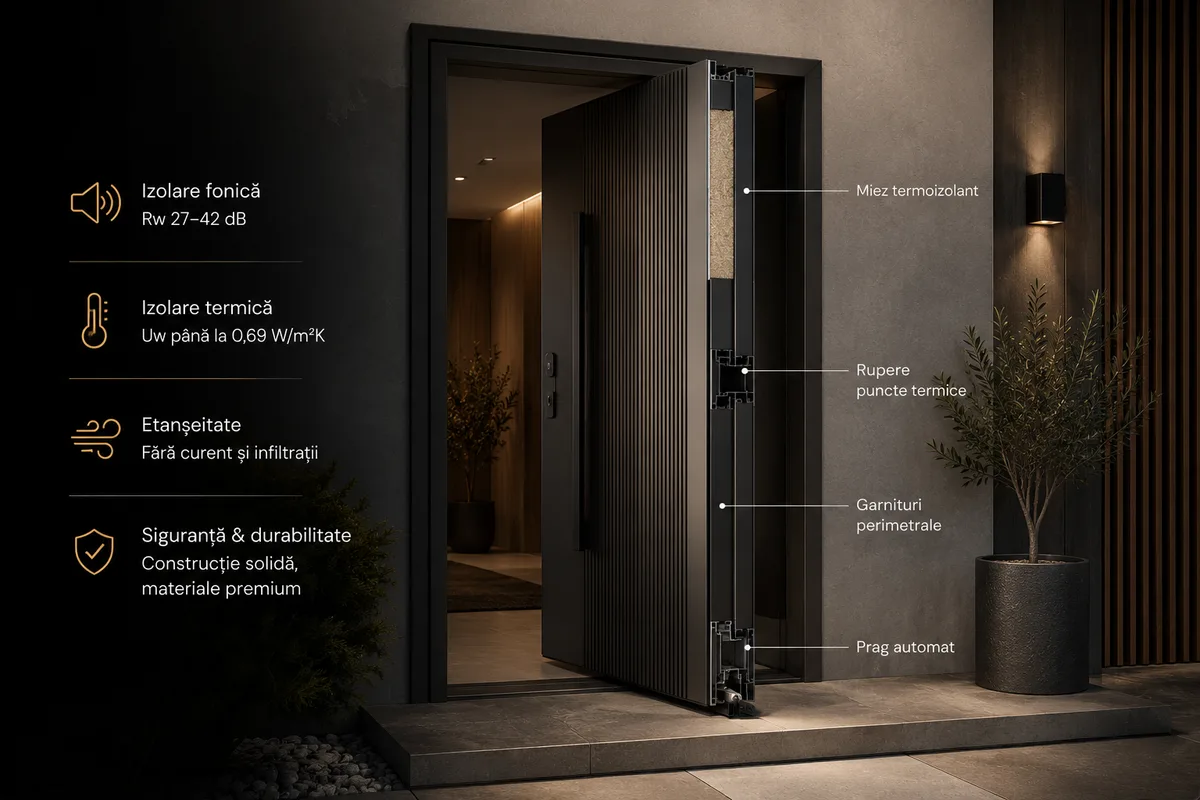
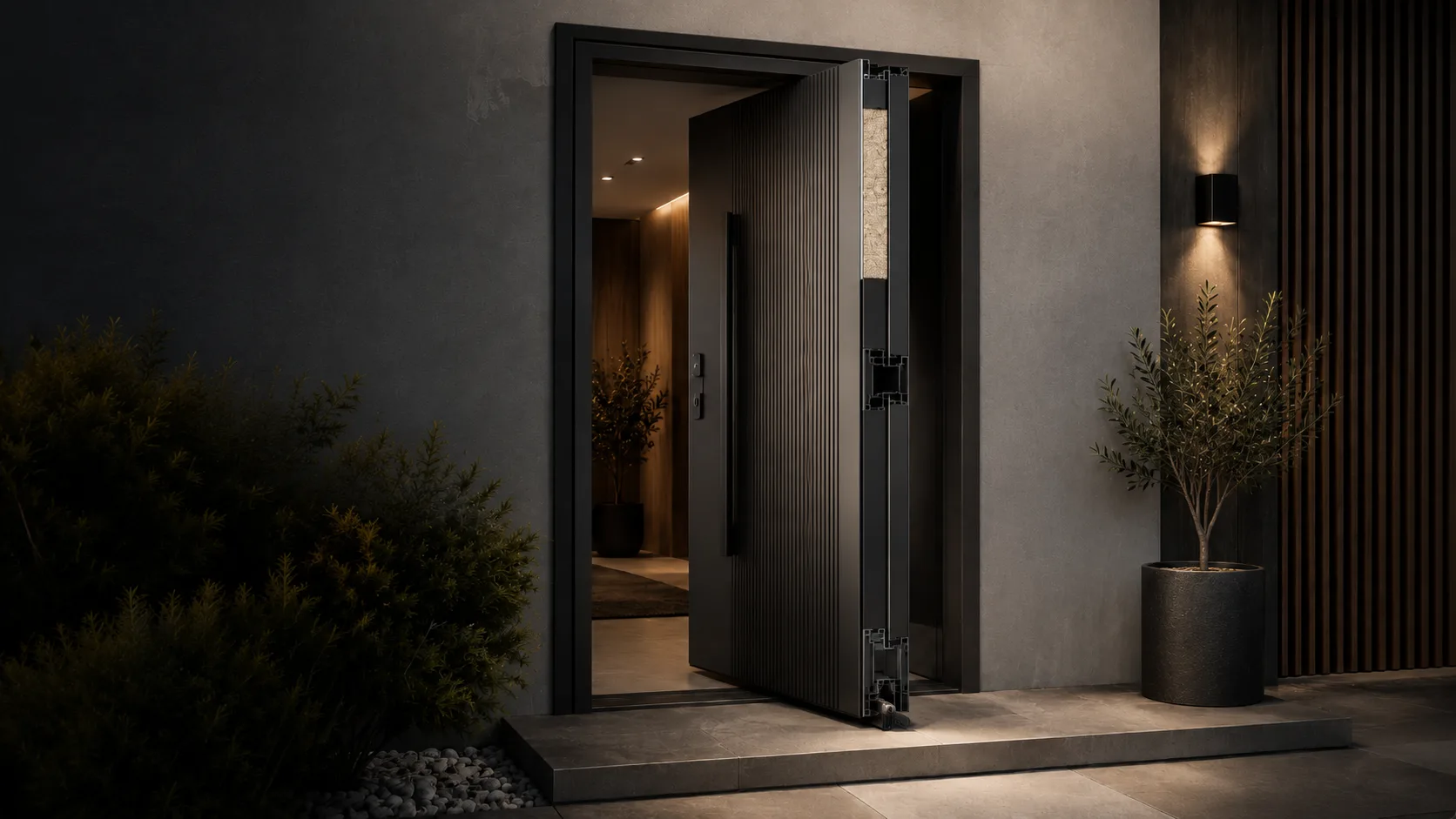
The door material is what determines the acoustic and thermal insulation. The seals and the threshold add airtightness, but they do not make up for the material.
The main materials in today's entrance doors:
- Polyurethane foam (PU foam): the standard core for metal doors. Good thermally, moderate acoustically. Variable density and thickness.
- Basalt mineral wool: better acoustically than polyurethane, fire-resistant. Used in premium doors and buildings with fire-resistance requirements.
- EPDM perimeter seals: the current standard, with a service life of 5-8 years. To be checked annually.
- Magnetic seals: superior airtightness without pressure on the frame. Used on premium doors and passive doors.
- Aluminium profiles with a thermal break: eliminate the thermal bridge through the frame. Mandatory on doors for energy-efficient homes.
The seal and the threshold: the most often neglected parts of door insulation
A worn seal significantly reduces the acoustic insulation of a good door. It is the most common reason why an otherwise solid door insulates poorly after a few years.
A simple check: if you can see light around the edge of the door when it is closed, the seal is no longer airtight. If you feel a draught under the door, the threshold is the problem.
Threshold insulation
An automatic threshold insulates acoustically better than a fixed threshold. It drops automatically when the door closes and eliminates air leakage underneath. On aluminium doors for passive or energy-efficient houses, an automatic threshold is not optional.
If the door is structurally sound, replacing the seals and the threshold costs far less than a new door. If the seals have already been replaced once and the problem has returned, the product can no longer sustain the required performance.
Which type of entrance door offers superior insulation
If you are looking for the best exterior door for your home, it is advisable to choose a model with a higher level of insulation.
The exterior material influences durability and appearance, while the core and the frame profile influence the insulation. Do not confuse the two.
| Material | Typical acoustic insulation | Typical Uw | Durability | Suitable for |
|---|---|---|---|---|
| Metal (steel) | 28-35 dB | 0.8-1.3 | 30+ years | Flat, higher security |
| Solid wood | 28-35 dB | 1.0-1.4 | 20-25 years | House, traditional look |
| PVC | 25-30 dB | 0.8-1.2 | 20 years | Flat, value for money |
| Aluminium | 28-38 dB | 0.6-1.0 | 30+ years | Passive house, villas, commercial |
*Indicative market values, taken from manufacturers' specifications. Check the technical sheet of the product you choose.
What thermal insulation is required for exterior doors intended for passive and energy-efficient houses
A certified passive house requires Uw ≤ 0.8 W/m²K for doors and windows. An energy-efficient house works with Uw ≤ 1.0 W/m²K.
The configurable aluminium doors we install at Kulttur reach Uw 0.69 W/m²K.
If you are building or renovating with high insulation requirements, the door's Uw is only one indicator. What also matters:
- the quality of the frame installation (thermal bridges through the frame)
- the type of threshold (automatic or fixed)
- the airtightness class against air leakage (L2 or higher)
If you want to know which configuration suits your home, you can book a free consultation. We come with the data, not with pressure.
See the exterior door collection
Insulation of interior doors: what is different from entrance doors?
Interior doors do not normally need thermal insulation. They do not separate environments at different temperatures. But the acoustic insulation of interior doors does matter, especially in the bedroom, home office or rooms with a television.
What changes compared with entrance doors:
- The values are lower, and that is normal. 20-30 dB is a realistic and good range for interior doors. Do not compare it with the 38-42 dB of entrance doors.
- The frame installation makes the biggest difference. An interior door fitted with an airtight frame insulates significantly better than the same door fitted without a perimeter seal on the frame.
- The panel material matters. Doors with a solid core, dense MDF or solid wood insulate better than those with a honeycomb core. At the same size and seemingly similar price, the difference is noticeable.
- Perimeter seals are not standard on all doors. Adding them makes a noticeable change to the acoustic comfort of the room.
If you want to improve the acoustic comfort of your rooms without a major renovation, replacing your interior doors with ones that have a dense core and airtight installation is one of the most effective investments relative to the floor area of the home.
See the Kulttur interior door collection
Which common mistakes sabotage door insulation
Faulty frame installation. The most common reason why a good door does not insulate as it should. A frame fitted with unfilled gaps or without thermal sealing cancels out the quality of the material. This is sorted from the start, not after the door has been fixed in place.
An unsealed threshold, or a fixed threshold where an automatic one is needed. More draught and noise come in under the door than around the seals. An automatic threshold sorts this out every time the door closes.
Worn seals that are not replaced. Average service life: 5-8 years. If they have never been changed on a door that is 10+ years old, that is the first problem to sort out.
Choosing a door solely on looks or a low price. A door with a honeycomb core looks the same as one with a PU core. It does not feel the same.
Improving the seals on a door with limited specifications. New seals reduce air leakage. They do not add acoustic insulation that the door's core does not have.
A metal frame without a thermal break. On aluminium or metal doors, a frame set directly into the wall creates a thermal bridge. The door's Uw becomes partly irrelevant.
How much door insulation costs
The decision depends on the cause of the problem, not on the budget.
If the door is structurally sound (airtight frame, intact core, less than 10 years old), new seals and an automatic threshold sort out the draught and part of the noise. The cost is significantly lower than a full replacement.
If the door has a degraded core, a frame fitted without sealing or outdated specifications, a full replacement is the only useful solution. New seals on a door unsuited to the desired level of comfort mean the intervention has a limited effect.
The factors that influence the price of a new entrance door:
- The exterior material (metal, PVC, aluminium, wood)
- The required insulation ratings (Uw and Rw)
- The dimensions of the opening and the configuration
- The type of hardware and the security systems
- Installation and frame, included or separate
That is why the cost of insulation should not be judged only by the intervention you make now, but by how long the door will work correctly. Sometimes it is more efficient to choose a well-built entrance door from the outset, with a suitable frame, core, seals and hardware, than to buy a lower-quality door and keep modifying it over time with thresholds, seals, adjustments or repairs.
A good example is a Wippro Damburit exterior door, with a slate panel, installed in 2009 in a house in Bucharest, which needed its first adjustment only after 17 years. This is the kind of difference that quality chosen from the outset can make.
Frequently asked questions about entrance door insulation
What do Rw or dB mean for a door and how much is enough?
Rw is the noise reduction indicator, expressed in decibels. A 10 dB increase means you perceive roughly half the noise. A realistic minimum for a flat: 27-30 dB. On a boulevard or with noisy neighbours, 35 dB and above makes the difference. Always check the Rw declared by the manufacturer in the technical sheet, not just the door material.
What is the difference between the acoustic and thermal insulation of an entrance door?
Acoustic insulation blocks noise and is measured in dB. Thermal insulation reduces heat loss and is measured by Uw (W/m²K). They are achieved through different materials and are not mutually exclusive. A door can be good at one and poor at the other. Check both values when comparing products.
Why is there a draught around the entrance door, even when it is properly closed?
The most common cause: the perimeter seal has worn out or the threshold is no longer airtight. Check with your palm along the edges and along the bottom, with the door closed. If you feel air, the seal or the threshold needs replacing. If the problem persists after replacement, the frame was not fitted airtight during installation.
Do new seals help with acoustic insulation or do they only stop draughts?
New seals fix air leakage, which also contributes to noise. But acoustic insulation comes mainly from the door's core. If the door is rated at Rw 25 dB, new seals can add 2-4 dB. They cannot recover the difference from a door with a good core at 35 dB.
How much does an entrance door with good acoustic and thermal insulation cost?
The price varies depending on the material, the required ratings, the dimensions and what the offer includes: installation, frame, hardware. At Kulttur we do not publish standard prices for entrance doors, because every configuration is different. Book a free consultation and we will put together an offer once we have seen the opening and your real requirements.
Is it worth acoustically insulating the interior doors of a flat as well?
Yes, especially for the bedroom, home office or rooms with a television. Realistic values for interior doors are 20-30 dB, lower than for the entrance, but enough to significantly reduce noise from the hallway or living room. The main factor is the frame installation.