Parquet Installation Instructions
You would like to install parquet in your home yourself, but you're not sure how or where to start? It is essential that before any personal project of this kind, you inform yourself thoroughly, studying the options available to you, carefully choosing the products and materials you purchase, as well as the steps you need to follow. First and foremost, build yourself a plan based on advice from specialists in the field, calling on professionals when necessary. If you wish to lay the parquet entirely yourself (possibly with the help of those close to you), read this article to learn about the types of parquet you can choose from, the surfaces on which it can be installed, as well as the basic instructions for completing this project.

- What are the main types of parquet?
- Double-layer parquet
- Triple-layer parquet
- Industrial parquet
- Double-layer parquet
- Triple-layer parquet
- Industrial parquet
- How is parquet installed?
- Proper preparation of stratified parquet
- Support layer – the "Foundation" of parquet boards
- How to correctly install stratified parquet boards?
- Should the door be installed before or after the parquet is laid?
- Proper preparation of stratified parquet
- Support layer – the "Foundation" of parquet boards
- How to correctly install stratified parquet boards?
- Should the door be installed before or after the parquet is laid?
- Top useful tips
1. What are the main types of parquet?
Double-layer parquet
Due to technological development and the desire for innovation, as an alternative to solid wood parquet, stratified parquet boards were created. The main improvement it offers is the reduction (and even elimination, with proper care) of joints that can appear over time between solid wood boards. This type of parquet is produced using two layers of fibers that are cross-laminated and processed to ensure much more precise joints. Double-layer parquet boards are made from very well-dried wood, with their layers arranged so that the stability of the final product is maximized, thus eliminating the possibility of warping.
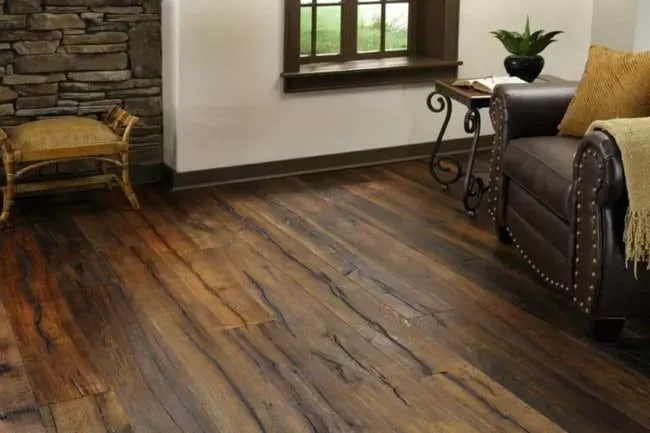
The upper noble layer is responsible both for the appearance that the parquet offers and for providing resistance to expansion, as well as to physical factors that can affect it (impacts, scratches). Like solid wood parquet boards, double-layer parquet has a distinctive, elegant appearance, suitable for various design styles. In case of damage due to mechanical action or simply the passage of time, the outer surface can be sanded and by applying a layer of finish (lacquer), the final appearance will be "like new". Double-layer parquet is installed very quickly and can even be installed in rooms that have underfloor heating systems.
Triple-layer parquet
Industrial parquet
Before starting the reconditioning process, the work surface must be inspected to identify any problems, with emphasis on correcting them.
Subsequently, to complete this first step, the parquet must be properly cleaned to remove any impurities from its surface. It is recommended to use a vacuum cleaner and a fine, damp cloth.
This type of parquet is specially created to withstand heavy traffic, being composed of:
- Small-sized strips;
- Blocks in parallelepiped shape.
The interlocking and joining of these pieces and the insertion of colored wood strips allows the creation of an infinite range of chromatic and aesthetic combinations. Industrial parquet is very durable over time, which is one of the main reasons it is predominantly used in the HoReCa sector (restaurants, ballrooms, hotels, etc.), in commercial spaces and warehouses, without excluding its use within a personal residence (apartment or house).
Proper preparation of stratified parquet
How is stratified parquet installed?
An essential step for the correct installation of stratified parquet is the acclimatization of the boards, so that they are thermally prepared for the assembly and fixing process. To last for an extended period of time, it is important to choose products of high quality, which are capable of withstanding many external damaging factors, including heavy traffic and large weights.
It is recommended that the boards be left in the room where they will be installed for approximately 2 days, and the temperature in the room felt at floor level should be between 18 degrees Celsius and 25 degrees Celsius. The boards must be kept in the box throughout the acclimatization period. Keep in mind that temperature variations in the room should NOT change drastically from one day to the next (maximum 5 degrees Celsius difference).
The humidity in the room is recommended by specialists to be between 40-60%, thus preventing the creation of cracks at the level of the strips.
- Support layer – the "Foundation" of parquet boards
Before positioning, placing, joining and fixing stratified parquet boards, a "support layer" must be applied which serves as a foundation for the wood. Most often, screed is used. This must meet special criteria:
- Specific flatness values are required (deviations between 4mm and 2m linear);
- A maximum residual moisture not exceeding 2% according to carbide hygrometer measurement;
- Pull-off strength varies, depending on how the parquet boards are actually installed.
The adhesive used in the support layer contains specially treated powerful adhesives, which are semi-rigid, facilitating long-term floor stability. For underfloor heating, silane-based adhesives are recommended; for screeds without heating, two-component adhesive can also be used. To improve the properties of the screed, primers are often used on construction sites to prevent (or reduce) moisture and dust, special resins to create a solid base and vapor barrier, and when necessary, in special cases, self-leveling screeds are used to achieve flatness.
Once the above conditions are met, the actual installation of the parquet boards follows, taking into account the special requirements of stratified parquet boards in relation to the composition of the adhesive used, varying depending on several factors, including:
- The type of screed used;
- The type of support layer;
- The type of wood of the stratified parquet boards;
- The intensity, frequency and weight of traffic to which the parquet will be subjected.
Parquet boards are recommended to be oriented parallel to the direction of the main light source, for a harmonious overall appearance.
It is ideal for the parquet to have, at installation, a calculated margin to allow for expansion, both in length and width, especially if the floor surface is larger than 10mm.
For rooms in a T / L / U shape, joints between parquet / floors must be made taking into account the extension of the room, using special system profiles.
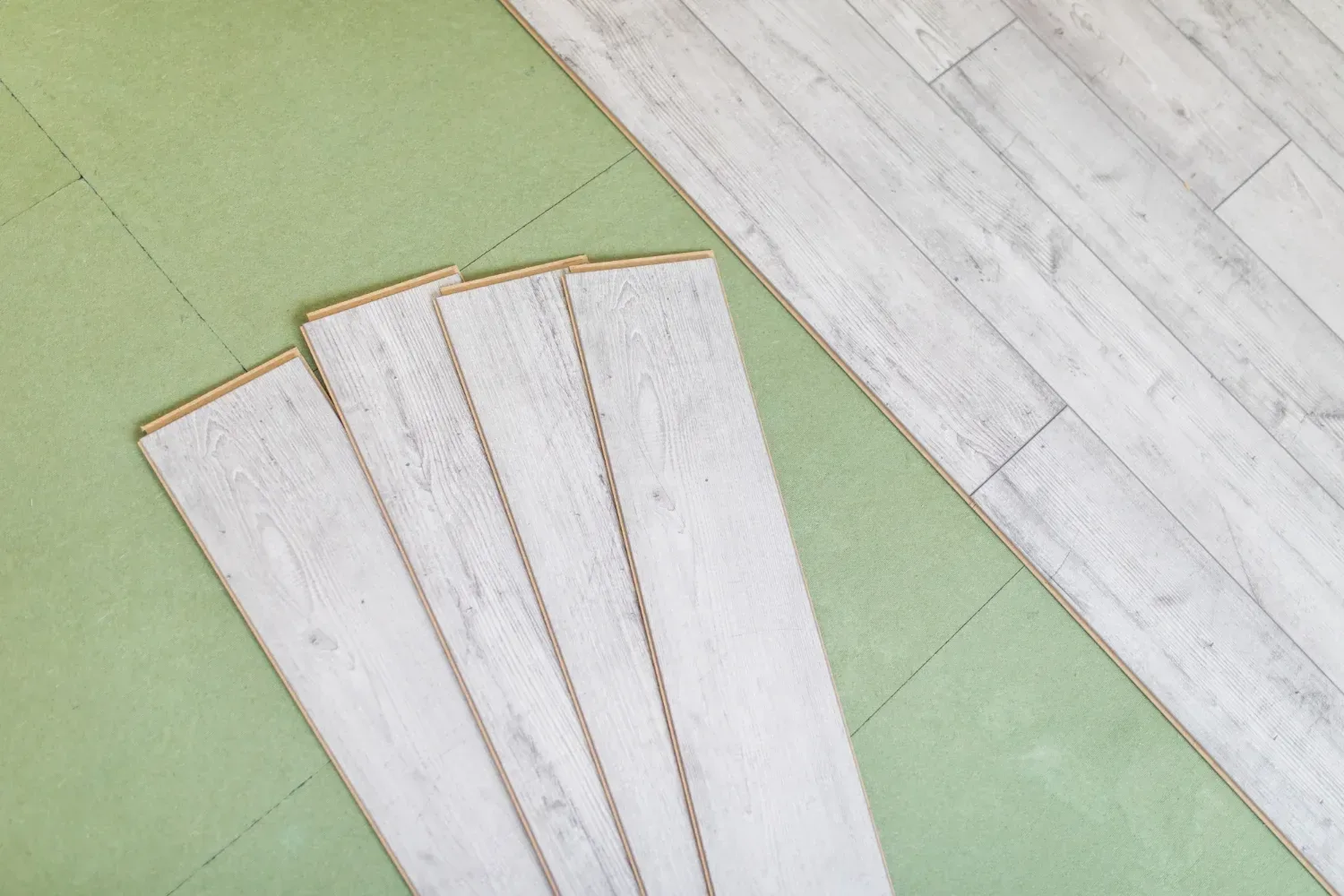
- Step 1: Installation should be started from the right corner of the room, the first board being fixed with the help of a spacer, at approximately 10 mm perimeter (so the wood can expand without problems).
- Step 2: The following boards are placed using the tongue-and-groove joint, parallel to the wall, in a horizontal direction, to first complete the first row, not the first column. The strips of the first row must be installed using a hammer and a special tapping block.
- Step 3: On the short sides, where the strips are tapped, an angle can be made on the left side, between the stratified parquet boards that you are about to join.
- Step 4: The second row is done after the measurement of the last board on the first row is completed, leaving a 10 mm margin between the wall and the strip. If necessary, the strip must be cut to be adjusted and fixed with the help of the special pushing device.
- Step 5: Using the remainder of the strip from the first row, you can start joining the stratified parquet boards on the second row, to reduce possible waste.
- Step 6: The following rows must be installed board by board, the first being fixed to the previous row, the joint being made on the longest part of the upper row. The block must be used to fix the two, but without using too much force – a light tap is necessary.
- Step 7: With the help of the hammer or the block, the horizontal board is joined with the one on the right side. If the area does not allow easy access, the pushing device can be used.
- Step 8: For permanent accessories, such as water / heating pipes, before installation, the boards must be measured and cut (preferably with a saw) according to the dimensions taken, but keeping in mind the margin for expansion. This also applies to the joints of the work at the door frames, or the difference in the material used for the floor in the second room. Covering the expansion margin can be done by applying a threshold or a transition profile.
- Step 9: After removing the spacers, the baseboard can be installed.
Should the door be installed before or after the parquet is laid?
Specialists recommend that any major work (door installation, painting, window installation, etc.) be done before laying the parquet boards to avoid damaging them. However, it is essential that the threshold be installed after the parquet has been laid, so that any possible gap at the door level is covered.
3. Top useful tips
- Find a visual balance for each room, while maintaining a uniform style for the entire property. Chromatic and stylistic harmony is achieved based on the design and color of the furniture, walls (architecture) and useful objects, but without forgetting accessories and decorative items. If you wish to have contrasts to give a sense of luminosity, make sure they are based on appropriate combinations of shades and colors.
- To maintain the impeccable and fresh appearance of the parquet for an extended period of time, make sure it is properly maintained, using the right substances for its type or protecting it from wear scratches by installing anti-slip supports on the legs of furniture pieces (tables, chairs, wardrobes).
- Calculations must be done very carefully, so that distances are equal, expansion margins are correct, and joints are not noticeable, but offer a uniform appearance. In areas where boards need to be cut (most often due to pipes), take measurements twice, cutting the boards without rushing.
- The threshold has the role of concealing the space left between two rooms, masking the margin left for possible wood expansion.
- BEFORE INSTALLING THE PARQUET, it is necessary to check for possible leaks from radiators (or sink), trying to make any adjustments or modifications to the room and accessories (including wall painting), before you proceed with this stage of the renovation.
- If your floor has underfloor heating, it must be turned on before parquet installation, to relieve the screed and eliminate residual moisture.
- The baseboard must be installed after the parquet boards have been laid, as it has multiple roles, including fixing and maintaining them in place.