Installing Interior Doors
Planning a home renovation project and wanting to complete as much of it as possible yourself? One of the steps you may not yet know how to tackle is installing interior doors in your home. If you'd like to learn something new and achieve the desired results on your first attempt, keep reading to discover how to succeed in the shortest amount of time!
1. Planning and Investment (Purchasing)
2. How to install a door? Steps and useful tips for choosing and fixing interior doors!
2.1. Preparing for Installation
2.1.1. The Frame
2.1.2. The Door
2.2. Positioning the Frame and Door
2.3. Adjusting and Fixing the Frame to the Masonry
2.4. Filling the Space Between Frame and Wall
2.5. Repairs and Finishing
3. Criteria for Choosing a Door
4. Door Protection
1. Planning and Investment (Purchasing)
To do everything perfectly, you must be very attentive to every detail of this renovation work, especially when replacing an existing door. Therefore, before purchasing a new interior door, make sure to:
- Take accurate measurements after removing the old frame;
- Ensure that the wall material is strong enough to support the weight of the new door, as well as the process of removing and installing the new frame;
- Make a shopping list of items you need to purchase, ensuring you invest only in high-quality products;
- Browse online galleries of specialty stores to find a few models that would harmonize with your home's interior design;
- Visit a showroom to discuss your options with a specialist, enabling you to make an informed final decision;
If the existing market offer doesn't provide the model you're looking for, you can always order a custom door, giving you a unique design created specifically for you.
Your shopping list should include:
- Materials:
- Door;
- Frame;
- Related Accessories;
- Wooden Shims and Wood Strips;
- Sills;
- A Tube of Polyurethane Foam;
- Fastening (Sealing) Components;
- Appropriate Screws and Anchors;
- Plaster;
- Adhesive Tape;
- Silicone Sealant Adhesive;
- Wagner Nails.
- Door;
- Frame;
- Related Accessories;
- Wooden Shims and Wood Strips;
- Sills;
- A Tube of Polyurethane Foam;
- Fastening (Sealing) Components;
- Appropriate Screws and Anchors;
- Plaster;
- Adhesive Tape;
- Silicone Sealant Adhesive;
- Wagner Nails;
- Necessary Tools:
- Masonry Tape Measure;
- Hand Saw;
- Pencil;
- Electric Drill;
- Masonry Hammer;
- Masonry Level / Spirit Level (with bubble);
- Spray Bottle (household);
- Plastic Tray;
- Small Putty Knife;
- Cutter (25 cm);
- Special Gun for Foam Tube.
- Masonry Tape Measure;
- Hand Saw;
- Pencil;
- Electric Drill;
- Masonry Hammer;
- Masonry Level / Spirit Level (with bubble);
- Spray Bottle (household);
- Plastic Tray;
- Small Putty Knife;
- Cutter (25 cm);
- Special Gun for Foam Tube.
2. How to Install a Door? Steps and Useful Tips for Choosing and Fixing Interior Doors!
Before installing a door, it must be selected based on well-established criteria, such as:
- Door Dimensions (including frame measurements) – measured from the available wall space after the old frame has been removed;
- Wall thickness and the material the masonry is made from;
- The direction the door opens;
- Door Design (shape, inserts, colour, etc.) and its fastening system.
2.1. Preparing for Installation
2.2. Positioning the Frame and Door
- The Frame
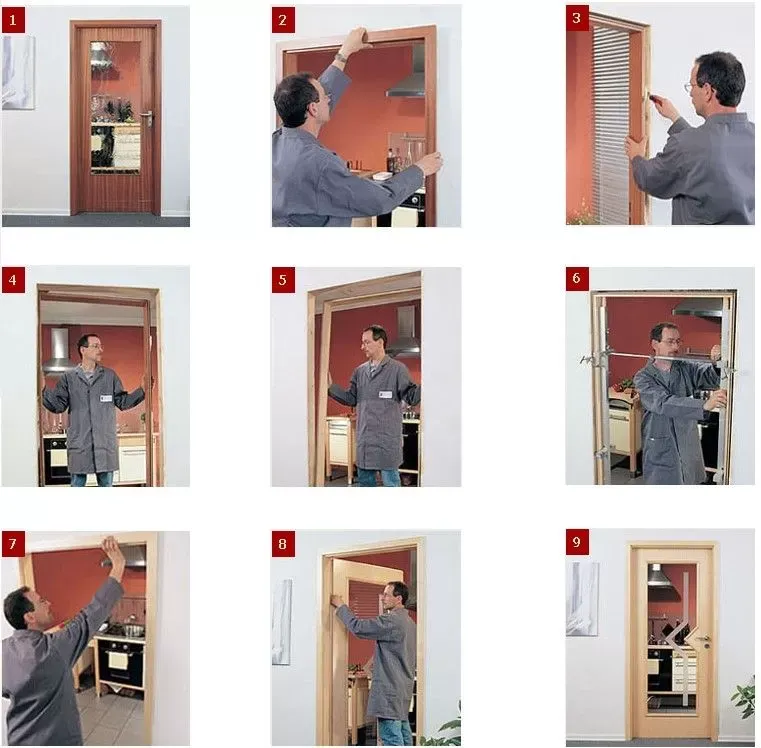
To install the new frame in the wall, the old door frame must be completely removed, the remaining space cleaned, and the walls levelled if necessary. It is very important that the dimensions of the empty wall space match the size of the ordered door (+ corresponding frame). When the purchased door has a frame that is taller than the available space, it can be cut (adjusted) manually with a hand saw (taking into account the "grounding" that must be done to the floor).
- The Door
The door is placed in its frame exactly where it is to be installed, but is supported by 2 wooden shims (approximately 5 cm) underneath, creating space between the door and the floor.
The frame and door must be in their placement location, with the frame fixed (locked) in place using wooden shims or special mechanical anchors. You must continuously check the perpendicularity, verticality and parallelism of both, relative to both the floor and the wall, using a spirit level and a measuring tape. One very important detail to note is the equality of the diagonals within the frame.
2.3. Adjusting and Fixing the Frame to the Masonry
2.4. Filling the Space Between Frame and Wall
With the frame fixed to the masonry, drill holes using an electric drill with a wood bit, then change the bit depending on the wall material. The holes made in the frame wood are countersunk to allow the screw heads to be recessed. Finally, install the anchors and screws.
The holes in the floor where the frame legs entered are sprayed with water using a spray bottle. After the water has been absorbed by both the wood and the floor, pour freshly mixed concrete grout, levelling it with a small putty knife.
Apply masking tape to the frame edges, ensuring it is well attached but can be easily removed later. Remove the wooden shims that helped secure the frame and use biocomponent foam (polyurethane) to fill the gaps between the frame and the wall.
Install the door panel, fitting and applying the hinges you purchased earlier.
2.5. Repairs and Finishing
3. Criteria for Choosing a Door
After the biocomponent foam has dried thoroughly, trim any excess with a cutter, and remove the protective tape from the frame. Conceal the joint between the frame and masonry by applying trim pieces (flat sills), which are fastened using silicone adhesive applied to their backs, then glued directly to the frame sides. For added security and reinforcement, you can use thin finishing nails. These trim pieces (sills) also come with other fastening options (click system, special nails, biocomponent foam, etc.), so choose what you find easiest to install.
When purchasing interior doors for your home, you should consider several essential criteria, including:
A. Hardness – The standard internal structure of the door is very important, as it influences both the product's durability and physical weight, though it can also have special characteristics:
- Cellular / Economy Structure ("honeycomb stabilization type") – has no special characteristics, ideal for residential homes;
- Structure with perforated chipboard and cylindrical internal voids – more resistant, and provides greater sound and thermal insulation;
- Structure with perforated chipboard with complete filling, without voids – the most resistant, guarantees complete sound insulation, helps maintain a constant temperature, ideal for office spaces.
B. Finish (Exterior Material)
- Wood (plain / painted / with sticker / etc.);
- Laminate;
- CPL;
- Veneer;
- Glass.
C. Frame Type
- Covers the Wall (sill);
- Recessed into the Wall (frame only);
- Frameless.
D. Design and Accessories
- Glass / Plexiglas / Mirror;
- Metal Inserts;
- Door Style:
- "Panel";
- Smooth Surface; - Lock / Handle:
- Handle – lever or rotating knob;
- Door Closing System.
E. Door Type
- Classic;
- With External / Internal Pivot Hinges;
- With External / Internal Sliding Hinges; - Double Sliding:
- Sliding Door Exterior;
- Sliding Door Inside the Wall ("pocket door"). - Folding;
- "French" Door (double opening).
F. Door Opening
- Interior;
- Exterior;
- Lateral Sliding.
3. Door Protection
Regardless of the door type or materials from which it is made, like any other product, it must be properly maintained. You can install a permanent stopper on the wall towards which the door opens, preventing not only damage to the handle, but also protecting the masonry.
It is recommended to use special cleaning products for your door, selected according to the material from which it is made.
Try to avoid excessive humidity in your home by maintaining a moderate temperature that benefits both your health and comfort, while also providing optimal conditions for the products you have purchased.